12 Abstract Philosophical Questions Explored Through Comics
Can a comic strip answer what it means to be alive? This question first struck me while sketching early pages of my comics, watching my rat characters navigate existential dilemmas through a maze of ink and paper. As the creator of the Eisner-nominated philosophical graphic novel The Labyrinth, I’ve dedicated my creative practice to transforming complex philosophical ideas into accessible visual narratives. Abstract philosophical questions are foundational inquiries that probe our deepest assumptions about reality, meaning, consciousness, and human experience – questions like “What is the meaning of life?” and “Are we truly free?” Unlike practical questions with clear answers, these inquiries resist resolution yet shape how we understand ourselves and navigate the world.
My mission is simple yet ambitious: make abstract philosophical concepts emotionally engaging and visually accessible through the unique storytelling capabilities that only comics provide. Philosophy questions the most fundamental aspects of our lives and should speak to everyone – not just intellectuals. Comics, with their dynamic interplay of text and image, create a cognitive bridge that helps readers grasp abstract concepts through concrete visual metaphors. When done well, philosophical comics not only explain ideas: they invite readers to experience them.
Why Ask Abstract Philosophical Questions in a Visual Medium?
Abstract philosophical questions are those foundational inquiries that resist simple answers yet seem impossible to ignore. They address the nature of reality, consciousness, morality, time, and meaning – concepts that often feel too slippery for words alone. These abstract philosophical questions matter because they shape how we understand ourselves and navigate our world, even when operating in the background of our everyday thinking. Our capacity to step back and question our own existence is both what makes us human and what creates our most profound philosophical dilemmas. Many of these inquiries overlap with existential questions – those urgent personal inquiries about freedom, mortality, and meaning that emerge from the human condition.
Comics are uniquely suited for exploring abstract philosophical questions for several compelling reasons. First, they harness the power of visual metaphor – transforming invisible concepts into visible forms. When I draw a character literally standing at a bifurcation in a maze to represent existential choice, readers can see and feel the difficulty of making life choices. This unique cognitive power of comics has been explored extensively in Scott McCloud’s essential work Understanding Comics, which itself uses the comic form to analyze how sequential art creates meaning.
Second, comics operate in multiple dimensions simultaneously. On a single page, I can present multiple timeframes, layers of consciousness, or parallel realities – perfect for illustrating complex philosophical problems. The gutter between panels becomes a space where readers actively participate in meaning-making, engaging their minds in precisely the kind of imaginative thinking that philosophy demands.
Finally, comics combine the emotional impact of art with the precision of language. This dual pathway into understanding helps bridge the gap between abstract reasoning and lived experience – exactly where philosophical questions become most meaningful.
12 Abstract Philosophical Questions at a Glance
| Question | Comic | Creator | Core Insight |
|---|---|---|---|
| What is the meaning of life? | The Labyrinth | Ben Argon | Meaning emerges through choices, not predetermined destiny |
| How should we face mortality? | Blankets | Craig Thompson | Understanding comes through emotional experience, not abstract reasoning |
| What is the nature of reality? | Logicomix | Doxiadis & Papadimitriou | Self-referential structures mirror reality’s paradoxes |
| What is consciousness? | Neurocomic | Ros & Farinella | Comics bridge the gap between physical brain and subjective experience |
| What is personal identity? | Daytripper | Moon & Bá | Identity exists in connections between moments, not isolated events |
| What is justice? | Persepolis | Marjane Satrapi | Justice is best understood as lived experience, not theory |
| Is morality objective? | Watchmen | Moore & Gibbons | Visual techniques embody competing ethical frameworks |
| What is the good life? | Peanuts | Charles Schulz | Wisdom emerges from balancing acceptance with creative transformation |
| Are we truly free? | V for Vendetta | Moore & Lloyd | Visual metaphors reveal invisible dimensions of social control |
| What is time? | Here | Richard McGuire | Simultaneous temporal layers challenge linear perception |
| How does history shape identity? | Maus | Art Spiegelman | Visual metaphor makes historical forces tangible |
| Can we understand others? | Building Stories | Chris Ware | Format mirrors the interpretive work of understanding minds |
12 Abstract Philosophical Questions & Their Visual Explorations in Comics
❓ What is the meaning of life?
Comic: The Labyrinth by Ben Argon
This question stands at the heart of existentialist philosophy and human experience itself. We seek patterns, purpose, and significance in our existence, wondering if meaning is discovered, created, or perhaps entirely illusory.
In The Labyrinth, I transformed Sartre’s existentialist ideas into a visual adventure where two rats navigate a maze-like world. The comic illustrates how meaning emerges through our choices rather than being predetermined. The rats in the maze stop running long enough to ponder the meaning of life: is it enough to “chase the cheese”? Or could there be more to existence? As they traverse the maze, new possibilities and questions arise.
The labyrinth itself serves as both setting and metaphor, allowing readers to physically see how structure impacts freedom and how seemingly arbitrary choices accumulate into a life’s trajectory. When my protagonist rat gazes at the stars from within maze walls, the contrast between cosmic scale and individual limitation creates a visual tension that captures existential absurdity more immediately than words alone could convey.

❓ How should we face mortality?
Comic: Blankets by Craig Thompson
Our finite nature shadows every human experience. How we conceive of death – as ending, transition, or transformation – profoundly shapes how we live and what we value in the time we have.
Thompson’s Blankets explores mortality through coming-of-age experiences rendered in fluid, emotive linework. The graphic novel doesn’t philosophize about death directly but shows characters grappling with temporality through relationships, religion, and art. Thompson’s snowy landscapes serve as perfect visual metaphors for impermanence – vast expanses that simultaneously represent beauty, isolation, and the ephemeral nature of experience.
The book’s visual poetry captures something essential about facing mortality: that understanding often comes through emotional and sensory experiences rather than abstract reasoning alone. When the protagonist contemplates eternity through both Christian doctrine and artistic expression, the tension plays out in panels that literally expand beyond conventional borders – a visual technique that mirrors how confronting mortality often pushes us beyond our comfortable thought patterns.
❓ What is the nature of reality?
Comic: Logicomix by Apostolos Doxiadis & Christos Papadimitriou
This foundational question has occupied thinkers from Plato to quantum physicists: Is reality objective or subjective? Material or mental? Fixed or fluid? Our answer shapes every aspect of how we interpret our experiences and construct knowledge.
Logicomix brilliantly chronicles Bertrand Russell’s quest for certainty in mathematics and logic – disciplines that probe reality’s fundamental structure. What makes this graphic novel exceptional is how it visualizes abstract mathematical concepts without sacrificing rigor. The artists create visual metaphors for logical paradoxes, making readers experience the disorientation that comes when reality’s foundations shift.
The nested narrative structure – a comic about mathematicians creating formal systems, drawn by artists being shown in the comic itself – creates a self-referential loop that perfectly mirrors the logical paradoxes the characters grapple with. This multilayered approach demonstrates how comics can make tangible the most abstract questions about what constitutes reality and truth.
❓ What is consciousness?
Comic: Neurocomic by Hana Ros & Matteo Farinella
Consciousness – our subjective inner experience – remains perhaps the most profound philosophical mystery. How does matter produce mind? Can consciousness be reduced to neural activity, or is something more fundamental at play?
Neurocomic takes readers on a journey through the physical brain, using surreal imagery to represent neurons, synapses, and neural pathways. What’s philosophically fascinating is how the comic visualizes the explanatory gap between physical brain processes and subjective experience. When characters navigate brain structures drawn as forests or oceans, readers simultaneously grasp both the material basis of consciousness and the phenomenological experience that seems to transcend it.
The book’s balance between scientific precision and imaginative visualization demonstrates precisely why comics excel at exploring consciousness – they engage both our analytical and experiential modes of understanding, much like consciousness itself operates at multiple levels.
❓ What is personal identity?
Comic: Daytripper by Fábio Moon & Gabriel Bá
Who am I, and what makes me the same person across time? Is identity found in psychological continuity, bodily existence, social relationships, or something else entirely? This question touches the core of how we understand ourselves and others.
Daytripper explores identity through multiple possible lives and deaths of its protagonist. Moon and Bá use the unique properties of sequential art to show how identity forms through narrative – the stories we tell about ourselves. Each chapter ends with the protagonist’s death at different ages, yet the character maintains a core identity across these alternate timelines.
What makes this work philosophically rich is how it visually demonstrates that identity exists not in isolated moments but in the connections between them. The artists use visual motifs that recur across different life scenarios, creating a sense of continuity that transcends circumstance. Their color palettes shift with each timeline while maintaining visual echoes – a perfect metaphor for how identity combines change and continuity. (Read more about Daytripper and the fear of death).
❓ What is justice?
Comic: Persepolis by Marjane Satrapi
Justice concerns the proper distribution of benefits and burdens in society and the correction of wrongs. But is justice universal or culturally relative? Based on rights, virtues, or outcomes? These questions fundamentally shape our political and social systems.
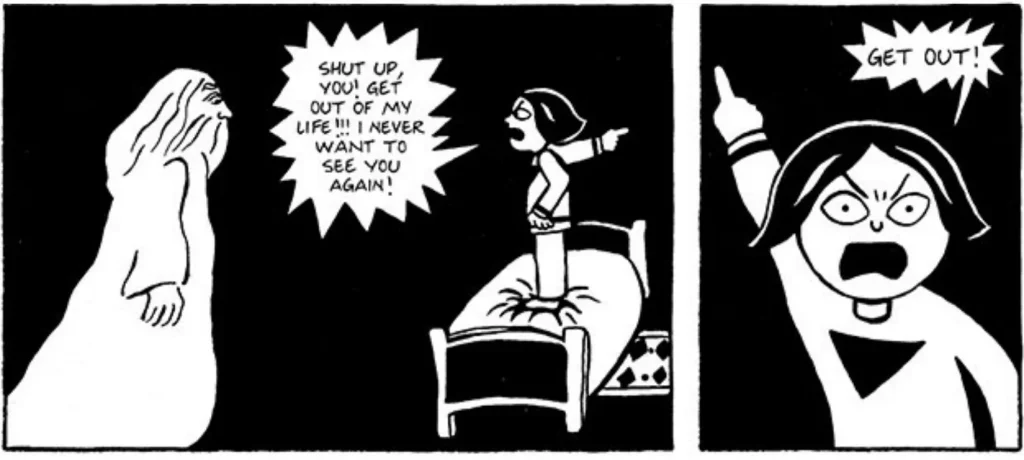
Satrapi’s autobiographical Persepolis doesn’t present a philosophical theory of justice – it does something more powerful. Through stark black-and-white imagery, it shows justice and injustice as lived experiences of a woman forced to live abroad during Iran’s Islamic Revolution. The minimalist art style creates a universal quality that makes abstract concepts of freedom, oppression, and resistance immediately accessible.
Particularly striking is how Satrapi uses visual juxtapositions – contrasting panels showing private versus public life under an authoritarian regime – to illustrate the tension between different conceptions of justice. When young Marjane argues with God in her imaginative dialogues, the comic visualizes the philosophical struggle between divine command theory and humanistic ethics in a way that philosophical prose rarely achieves.
❓ Is morality objective or subjective?
Comic: Watchmen by Alan Moore & Dave Gibbons
Are moral principles universal truths or human constructions? Do they exist independently of our beliefs and cultures, or are they relative to particular perspectives? These questions shape how we justify ethical claims and resolve moral disagreements.
Watchmen deconstructs superhero conventions to explore moral relativism through characters with radically different ethical frameworks. What makes the graphic novel philosophically sophisticated is how it embodies these perspectives not just in dialogue but in visual storytelling techniques. Rorschach’s absolutist morality is reflected in his black-and-white mask and uncompromising panel compositions, while Ozymandias’s utilitarian calculations appear in symmetrical, clinical layouts.
The comic’s famous nine-panel grid creates a rigid structure that both contains and highlights moral chaos – a visual metaphor for the tension between order and randomness in ethical systems. When Dr. Manhattan perceives all moments simultaneously, his godlike perspective challenges linear moral causality, raising profound questions about moral responsibility across time that only comics could visualize so effectively.
❓ What is the good life?
Comic: Peanuts by Charles M. Schulz
What constitutes human flourishing? Is the good life found in happiness, virtue, knowledge, or something else entirely? This ancient question remains strikingly contemporary as we make daily choices about how to live.
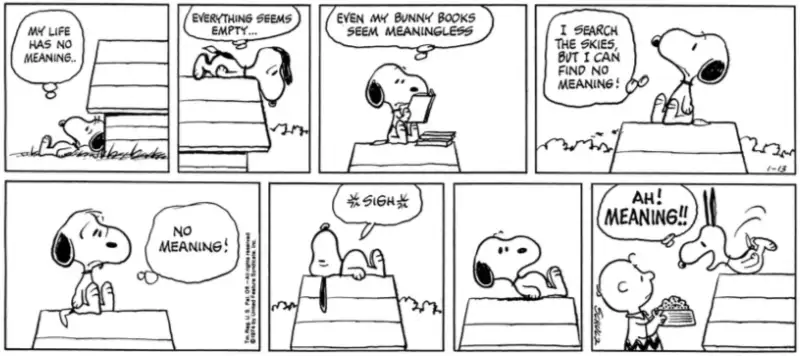
Schulz’s Peanuts might seem an unlikely philosophical text, but its exploration of childhood anxiety, friendship, and resilience contains profound wisdom about the good life. The strip’s minimalist aesthetic strips away distractions, focusing attention on essential human experiences. Charlie Brown’s persistent failures and small victories become parables about perseverance and finding meaning despite life’s inherent frustrations.
What makes Peanuts philosophically significant is how it balances Stoic acceptance with absurdist humor. When Charlie Brown misses the football again, the comic strip format – with its cyclical nature and eternal present – perfectly captures life’s repetitive challenges. Snoopy’s imaginative flights show another path to the good life: creative transformation of circumstances through imagination. Through these characters, Schulz visually demonstrates competing philosophical approaches to well-being with a simplicity that makes them universally accessible.
❓ Are we truly free in a society?
Comic: V for Vendetta by Alan Moore & David Lloyd
Political philosophy grapples with the tension between individual liberty and social cohesion. What constitutes genuine freedom? How should we balance personal autonomy against collective welfare? When is authority legitimate, and when does it become oppression?
V for Vendetta explores these questions through a dystopian narrative rendered in shadowy, expressionistic artwork. Lloyd’s visual techniques – particularly his use of symmetry, mirroring, and surveillance imagery – create a world where control is omnipresent yet often invisible. When V stands before the Old Bailey before destroying it, the panel composition visually pits individual will against institutional power.
The comic’s mask motif – both V’s Guy Fawkes disguise and the facades characters present to survive – creates a visual metaphor for the philosophical concept of false consciousness. Through these visual elements, the graphic novel makes readers experience the psychological dimensions of social control and resistance in ways pure text couldn’t achieve.
❓ What is time?
Comic: Here by Richard McGuire
Is time a fundamental feature of reality or a construct of human consciousness? Linear or cyclical? Absolute or relative? How we conceptualize time shapes our understanding of causality, memory, and meaning.
McGuire’s groundbreaking Here presents multiple timeframes simultaneously in the same physical space – a corner of a living room shown across thousands of years. The book doesn’t argue philosophical positions about time; instead, it creates a visual experience that challenges linear perception. By showing different time periods as frames within frames on the same page, McGuire achieves something prose cannot: the simultaneous perception of multiple temporal layers.
What makes this work philosophically profound is how it visually demonstrates time as both continuous and discontinuous. The consistency of physical space across wildly different eras creates visual connections that suggest patterns transcending individual moments, while the fragmentation of time into discrete panels emphasizes its discontinuity. This tension between continuity and discontinuity lies at the heart of philosophical puzzles about temporal existence.
❓ How does history shape identity?
Comic: Maus by Art Spiegelman
We are born into historical narratives that precede us and shape our sense of self. But how does historical trauma transmit across generations? How do we integrate inherited histories into personal identity? These questions connect individual psychology with collective experience.
Spiegelman’s Maus explores these questions through his father’s Holocaust experiences and their impact on their father-son relationship. The comic’s anthropomorphic approach – Jews as mice, Germans as cats – isn’t mere stylization but a philosophical statement about how categorization creates historical destiny. The visual metaphor makes tangible how historical forces shape individual identities even before birth.
What gives Maus its philosophical depth is its dual timeline structure, showing both past events and the present-day act of collecting testimony. This creates a visual dialogue between history and memory, documentation and interpretation. When Spiegelman draws himself at his drawing board wearing a mouse mask, the image encapsulates the philosophical tension between assuming historical identity and maintaining critical distance from it – a tension that defines intergenerational experience.
❓ Can we ever truly understand others?
Comic: Building Stories by Chris Ware
The problem of other minds – how we can know the inner experiences of others – has troubled philosophers since antiquity. Is empathy possible? Are we fundamentally isolated in our subjective experiences? How do we bridge the gap between minds?
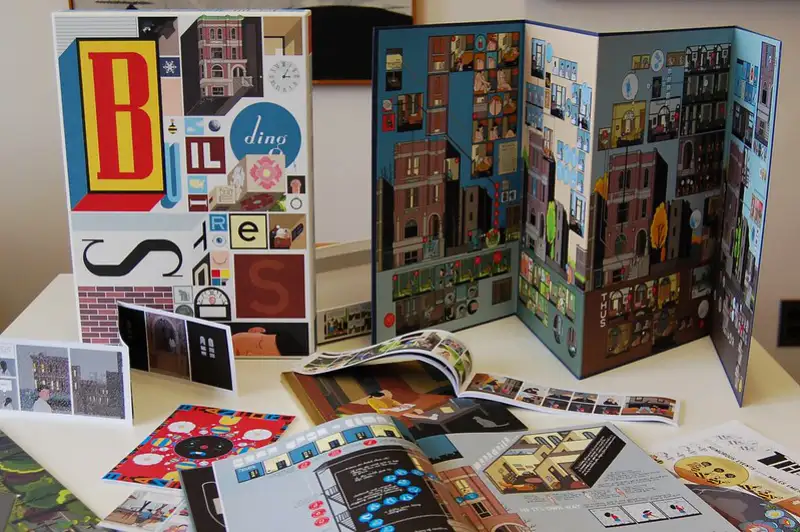
Ware’s Building Stories—a box of 14 different printed works rather than a traditional book – embodies these questions in its very format. By requiring readers to construct narrative connections between fragments, it mirrors the interpretive work required to understand others. The comic’s cutaway diagrams of buildings and bodies suggest that seeing inside physical structures doesn’t necessarily grant access to the thoughts and feelings they contain.
The work’s microscopic attention to everyday gestures and expressions visualizes the subtle cues we use to infer others’ mental states. When Ware shows the same scene from multiple characters’ perspectives, the shifting visual styles create a profound sense of how differently we experience shared realities. This approach makes readers experience both the possibility and limitations of understanding others.
An Invitation to Think Visually About Abstract Philosophical Questions
Abstract philosophical questions often feel intimidating precisely because words alone can trap us in circular reasoning or vague abstractions. Comics offer a different approach – one that grounds abstract philosophical concepts in concrete images, emotional experiences, and narrative contexts. As I discovered while creating The Labyrinth, drawing philosophy often reveals dimensions of thought that purely textual exploration might miss.
The graphic novels discussed here demonstrate how visual thinking can transform our engagement with abstract philosophical questions. Each work uses unique visual strategies to make abstract concepts tangible – whether through metaphor, panel structure, color, or composition. This visual dimension doesn’t simplify complex ideas but rather makes their complexity accessible through additional cognitive pathways.
After all, some questions are best answered not just with words, but with images that help us see what we’re thinking about.
Further Reading
To continue exploring, my philosophy comics essential guide offers a comprehensive introduction to the genre, while the best existentialism books provides reading paths for those drawn to questions of meaning and freedom.
Originally published on 16 May 2025 and last updated on 20 November 2025 by Ben Argon, creator of the Eisner-nominated philosophical graphic novel The Labyrinth and writer exploring the intersection of comics, philosophy, and visual storytelling at benargon.com