Graphic Memoirs: Essential Visual Autobiographies That Transform Personal Stories
Graphic memoirs are autobiographies told in comics, where panels, gutters, and the interplay of word and image recreate how memory actually works. The finest examples—Maus, Persepolis, Fun Home, Feeding Ghosts, Marbles—use visual choices to carry emotional truth that prose description cannot reach, which makes the form uniquely suited to trauma, displacement, and identity.
Is a drawn memory less true than a written one? More true?
Every memoirist wrestles with unreliable memory. Graphic memoirists face something harder. They must decide what memory looks like. Draw the childhood home in precise architectural detail, or as the emotionally distorted space a child actually moved through? Both are true. Neither is complete.
That decision is the whole medium in miniature, and it is why I keep returning to these books. In the philosophy comics I make, including my Eisner-nominated The Labyrinth, every line carries an argument. Memoirists work with riskier material: the specific, lived details of their own lives, rendered visible for strangers to witness. This article covers the essential graphic memoirs, the recent works extending the form, and what makes visual autobiography one of our most powerful storytelling modes.
What Makes Graphic Memoirs Different From Written Memoirs?
Graphic memoirs show rather than describe. Where a prose memoirist builds a scene from adjectives, a graphic memoirist draws it, and every visual choice becomes an argument about how that memory felt. The gutter between panels does the rest, forcing readers to supply the connective tissue from their own experience.
Art Spiegelman’s rough, urgent line work in Maus proves that unrefined drawing can carry truth more powerfully than realistic illustration. His hurried marks feel lived in, sketched in the margins of memory itself. Technical virtuosity would have made the book worse.
The commitment to autobiography shapes everything downstream. Spiegelman never describes his father’s cramped apartment. He draws us into it: cluttered surfaces, specific pill bottles, Holocaust trauma manifesting as hoarded newspapers.
The space between panels, what comics professionals call the gutter, carries particular weight in autobiographical comics. When Tessa Hulls breaks the traditional grid in Feeding Ghosts and lets her layouts follow the shape of intergenerational memory, the experimentation serves truth rather than technique. Readers construct meaning actively, filling gaps with their own experience.
Comics also do something film cannot. Treating them as storyboards misses the point: comics combine sequential images, page composition, and text at once, and the reader sets the pace. You can stop on a panel. Documentary footage sweeps you along. A drawn page lets you sit inside for a moment.
Drawing The Labyrinth, I kept returning to humor as a lens for difficult questions. Graphic memoirists use the same tool. Dry wit becomes a survival mechanism, a way of metabolizing pain without diminishing it.

Essential Graphic Memoirs
Maus by Art Spiegelman: Historical Trauma
Art Spiegelman’s Maus established graphic memoir as serious literature. Serialized from 1980 to 1991, it weaves two narratives: Vladek Spiegelman’s survival of the Holocaust and Art’s difficult relationship with his aging father while documenting that survival.
The visual metaphor seems almost childish at first. Jews as mice, Nazis as cats. Then you notice how it cuts through decades of familiar documentary footage and makes the predator-prey dynamic visible again. Maus is revolutionary because Spiegelman refuses to sanitize anything, neither the Holocaust nor his father’s abrasive personality.
His panel composition reinforces that refusal. He layers past and present on a single page: adult Art interviewing elderly Vladek in one tier, young Vladek surviving Auschwitz in the tier below. The gutters between those timeframes force readers to connect the trauma to its decades-long aftermath. Survival does not end when the camps are liberated.
The rough aesthetic is integral to the book’s power. These drawings feel urgent, almost unfinished, as though the story demanded telling before there was time to polish it. We are not watching reconstructed historical drama. We are watching memory emerge, messy and immediate.
Maus opened the door for other graphic novels exploring Holocaust experiences, proving comics could handle historical trauma with both artistic sophistication and documentary rigor.
Related Reads: They Called Us Enemy by George Takei recounts childhood in Japanese American internment camps. Stitches by David Small renders childhood medical trauma through haunting visual metaphor.
Persepolis by Marjane Satrapi: Cross-Cultural Coming-of-Age
Persepolis chronicles Satrapi’s childhood and young adulthood in Iran and Europe during and after the 1979 Islamic Revolution. Its power comes from rendering enormous political upheaval through grounded specifics of one girl’s life: mandatory veils at school, family friends who gradually stop appearing, the small rebellions of teenage parties and banned Western music.
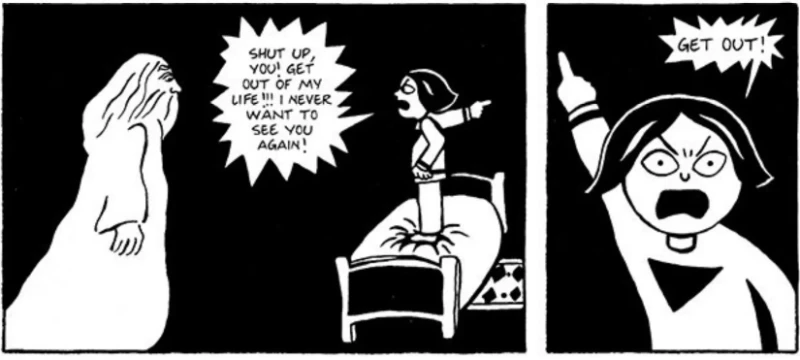
Satrapi’s stark black and white language makes the Revolution comprehensible without simplifying it. Her high-contrast approach is political. By eliminating gray values, she forces every element into stark clarity: complicit or resistant.
Watch what she does with crowds. Protest scenes reduce to fields of near-identical black shapes, faces barely differentiated, bodies merging into a single mass. Individual features disappear into collective form. The technique renders both the solidarity and the erasure of the period in one image.
Her simplified drawing keeps attention on story and character. Occasional surreal images, like young Marjane arguing with God, use visual metaphor to reach interior experience directly. Dry humor works as both coping mechanism and narrative strategy.
The layouts stay regular through most of the book, which makes the rare grid-breaks land hard. Restraint is what gives those moments their force.
Related Reads: The Arab of the Future by Riad Sattouf chronicles a childhood shuttling between France, Syria, and Libya, giving each country its own color palette. American Born Chinese by Gene Luen Yang combines autobiography, mythology, and satire.
Fun Home by Alison Bechdel: Family and Identity
Alison Bechdel’s Fun Home: A Family Tragicomic explores her fraught relationship with her father Bruce, a closeted gay man who taught high school English and ran the family funeral home. Published in 2006, it demonstrates how much complexity the form can hold.
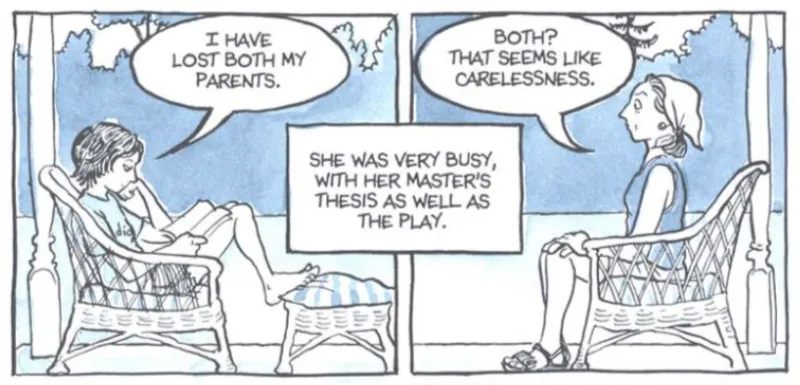
Bechdel uses caption-as-voiceover to create conversation between text and image rather than simple illustration. Her captions supply context, analysis, and literary allusion, while the drawings show the emotional truth underneath. Past and present coexist on the page. Memory is experienced and examined at once.
The book is deeply literary. Proust, Joyce, and Wilde thread through it because literature was how father and daughter communicated, circling truths neither could speak directly.
Her most quietly devastating device is the drawn document. Bechdel redraws letters, diary entries, maps, and photographs by hand rather than reproducing them. A photograph copied in ink is no longer evidence; it has passed through the daughter’s hand. The book keeps insisting on the gap between the record and the person reading it, and it makes that argument formally rather than stating it.
What moves me most is her refusal to simplify Bruce. Brilliant and cold, artistic and controlling, closeted and probably suicidal. The book holds every contradiction without resolving any of them.
Related Reads: Blankets by Craig Thompson offers a sprawling meditation on first love, faith, and family in flowing artwork. The Best We Could Do by Thi Bui traces a Vietnamese refugee family across generations.
Feeding Ghosts by Tessa Hulls: Intergenerational Trauma
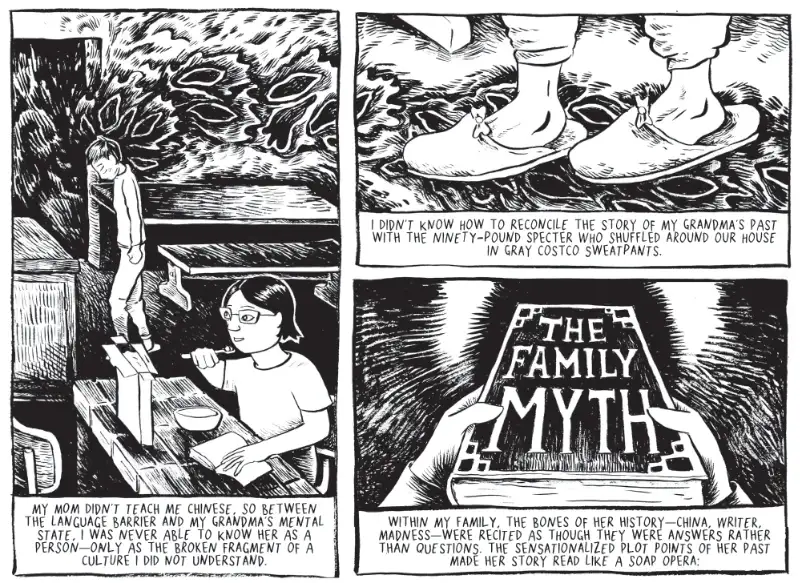
Tessa Hulls’s Feeding Ghosts won the 2025 Pulitzer Prize for Memoir or Autobiography and represents the form at its most ambitious. Nearly a decade in the making, it traces three generations of Chinese women across continents: Hulls’s grandmother Sun Yi, her mother Rose, and Hulls herself, through Chinese political upheaval, mental illness, and inherited trauma.
Its artistic range is extraordinary. Traditional grids give way to panels that expand, contract, overlap, and fragment. Page compositions follow the shape of memory instead of the shape of chronology. Events spiral outward from a central image; multiple timeframes layer transparently over one another. Reading it feels less like following a story than excavating one.
The scope runs from Shanghai under Japanese occupation through Maoist China to contemporary America, and never loses its intimate focus. Hulls uncovers her grandmother’s published memoir and must reckon with how much of it was fabricated or bent by trauma. The book becomes a meditation on inheriting not just stories but silences, distortions, and the survival mechanisms our ancestors needed.
The artwork shifts style with period and emotional register. Historical sequences use meticulous, researched depictions. The most turbulent passages abandon the grid altogether, forms breaking apart into brushed black ink until the page itself feels submerged. Structure reasserts itself slowly across the pages that follow. The form enacts the content.
Hulls reflects on the decade she spent making the book in her interview with The Comics Journal after the Pulitzer announcement.
Related Reads: Welcome to the New World by Jake Halpern and Michael Sloan chronicles a Syrian refugee family’s first year in America. Good Talk by Mira Jacob builds a memoir from conversations about race, identity, and family.
From My Studio
Every memoirist in this list faces the problem I face at my drawing table: how do you draw something that only ever happened inside someone’s head? They start from their own lives. I start from a question. What Is Life All About? is my 15-page attempt, in the same style as my Eisner-nominated The Labyrinth, taking philosophy’s oldest question and making it visible. Get it free here.

Marbles by Ellen Forney: Mental Health and Creative Identity
Ellen Forney’s Marbles: Mania, Depression, Michelangelo, and Me tackles bipolar disorder with brutal honesty and considerable energy. The visual style carries the immediacy: sketchy, varied line work that feels like flipping through her actual journals rather than a polished reconstruction.
Diagnosed shortly before her thirtieth birthday, Forney was terrified medication would kill her creativity. The book follows her years-long search for stability without losing her artistic identity. She researches historical “crazy artists” like Van Gogh and Virginia Woolf, testing whether creativity requires suffering.
Her line quality shifts throughout, sometimes frenetic and dense, sometimes controlled and spare, mapping her mental states directly. Manic pages crowd with detail, text spilling across panel borders, compositions fracturing into competing focal points. Depressive pages simplify and darken, negative space dominating, figures shrinking and isolating. How drawing style shapes meaning is the whole argument here, showing rather than telling how mood disorders reshape perception.
My own visual vocabulary draws as much from film noir and animation like Tex Avery’s as it does from comics, so I recognize what Forney is doing: borrowing the exaggeration of cartooning to depict states that realistic drawing would flatten into clinical illustration.
The central question, whether wellness and creativity can coexist, reaches past mental health. Forney argues the “crazy artist” mythology is dangerous as well as false, and the book proves it by existing. Here is vivid work made by someone taking medication and doing the work of recovery.
Related Reads: El Deafo by Cece Bell offers a charming middle-grade memoir about hearing loss and school. Mom’s Cancer by Brian Fies shows how illness affects everyone orbiting the patient.

What Are the Best Recent Graphic Memoirs?
The canon above spans thirty years. The form has not slowed down.
Bad Kid: My Life as a “Troubled Teen” by Sofia Szamosi is the most necessary recent entry. Szamosi was thirteen when her mother enrolled her in a “therapeutic wilderness program” three states away, and the book documents the American troubled-teen industry of the early 2000s from inside it. The drawing does something careful: it stays plain and matter-of-fact while describing institutional cruelty, and the flatness of the delivery is what makes it land.
Uprooted: A Memoir About What Happens When Your Family Moves Back by Ruth Chan follows thirteen-year-old Ruth from a comfortable life in Canada to Hong Kong after her father takes a job there. Chan renders adolescent dislocation without softening it into a lesson.
Visitations by Corey Egbert covers stranger ground. When his mother becomes convinced his father is the devil, Egbert ends up living on the run in the Nevada desert, forced to work out what he believes while still a child. The book handles an unreliable parent without ever caricaturing her, and the desert light does as much narrative work as the dialogue.
What strikes me across all three is how little they rely on the angles the previously cited authors made famous. No animal metaphor, no literary scaffolding. Each one finds its own way to draw a life, which suggests the form is still nowhere near its limits.
Why Do Graphic Memoirs Matter Now?
Memory does not work like prose. It fragments, juxtaposes, and jumps between past and present, which is exactly the structure comics are built from. That formal match makes graphic memoir uniquely suited to displacement, trauma, and identity, and explains why the form has drawn Pulitzers, a MacArthur, and widespread academic adoption.
Graphic memoirs and the wider adult graphic novel canon have grown steadily since Maus took its Pulitzer in 1992 because the format solves a real problem: how do you convey experiences that resist linear narrative?
These books combine accessibility and depth. The visual component invites readers who find traditional memoirs intimidating, while the layered storytelling rewards rereading. You return to a graphic memoir and find details, connections, and meanings you missed.
The recognition tells its own story. Spiegelman needed a Special Award in 1992 because no Pulitzer category fit Maus. Hulls won Memoir or Autobiography outright in 2025. The distance between those two prizes is the legitimation of an entire medium, measured in thirty-three years.
For those of us who make comics, these books are a standing challenge. They show what becomes possible when the full toolkit of sequential art renders not just events but their resonance across a life. I am drawing a philosophical science fiction now, an astronaut and a robot copilot at the edge of the cosmos, working on how perception shapes desire and fear. Every memoirist here got there first, using their own life as the material.
And for readers, these books offer a way into other lives, other perspectives, other ways of being human, made visible and immediate through words and images working together.
Originally published 1 November 2025 | Last updated 1 September 2026
By Ben Argon, philosophy comics creator and author of the Eisner-nominated graphic novel The Labyrinth, exploring the intersection of comics, philosophy, and visual storytelling.