Humor Theories in Comics: How Visual Jokes Make Philosophy Click
Humor theories illuminate how we process and understand complex ideas through laughter. My work creating philosophical comics has shown me how the use of humor transforms abstract concepts into accessible insights. I grew up with Charles Schulz’s Peanuts and Gary Larson’s The Far Side. These masterful comic artists showed me how visual humor could create profound “aha moments” about our existential condition. This early exposure shaped my approach to philosophical storytelling in my Eisner-nominated graphic novel The Labyrinth, where two rats navigate the maze of existence while bringing Jean-Paul Sartre‘s complex ideas to life.
The intersection of humor and philosophy in comics creates a unique alchemy. Visual metaphors, comic timing, and carefully crafted jokes work together to make challenging concepts understandable and memorable. Research shows that combining visual elements with humor significantly improves comprehension and retention of complex concepts.
The power of philosophical comics lies in their ability to harness three fundamental humor theories to illuminate complex ideas: Superiority, Relief, and Incongruity Theories. Readers engage with profound concepts through multiple levels of understanding. This happens when they smile at a rat questioning the meaning of life while searching for cheese, or when they see a rat slip on a banana peel representing harsh reality. These moments of humor create cognitive shortcuts that make abstract philosophical ideas tangible and relatable.
As we explore the relationship between humor theories and philosophical comics, we’ll uncover how this medium transforms complex ideas into engaging visual narratives. We’ll examine successful examples and understand the science behind visual learning. Through this exploration, we’ll see why comics have emerged as philosophy’s most accessible and engaging format.

Understanding the Three Major Humor Theories
Three major theories help us understand why and how we laugh, each revealing different aspects of the power of humor to communicate ideas. While philosophers and psychologists have debated these theories for centuries, their practical applications shine particularly bright in the world of comics and visual storytelling.
Three Humor Theories
The Superiority Theory dates back to Plato and was later developed by Thomas Hobbes. It suggests we laugh when we experience a sudden feeling of triumph or elevation over others or our former selves. This theory explains why we enjoy moments of intellectual victory – that satisfying chuckle when we grasp a clever concept or solve a philosophical puzzle. Imagine recognizing yourself in a comic character’s foolish actions, then laughing from the comfortable distance of self-awareness. This cognitive distance creates both humor and understanding.
Relief Theory, developed by Sigmund Freud and others, presents humor as a release valve for psychological tension. According to this framework, laughter provides relief from the mental strain of processing complex or uncomfortable ideas. Think about how a well-timed joke can break the tension during a challenging situation. Comics excel at this by introducing humorous elements precisely when readers need a mental breather from heavy ideas. The theory explains why philosophical comics can tackle profound existential questions without becoming overwhelming.
The Incongruity Theory focuses on the cognitive aspects of humor, suggesting we laugh when we encounter something that violates our mental patterns and expectations. This theory, supported by philosophers like Immanuel Kant and Arthur Schopenhauer, explains why unexpected connections and surprising juxtapositions make us laugh. In philosophical comics, this manifests through clever visual metaphors and surprising panel sequences that create new ways of seeing familiar concepts.
How Humor Theories Work Together
Modern humor researchers recognize that these theories often work together, creating multiple layers of engagement. A single comic panel might trigger superiority-based amusement through a character’s self-discovery, provide relief from conceptual complexity, and delight us with an incongruous visual metaphor – all simultaneously. This multilayered approach explains why comics can be so effective at communicating philosophical ideas.
Understanding these humor theories provides creators and readers with a framework for understanding how comics transform abstract concepts into engaging visual narratives. As we’ll explore in the following sections, successful philosophical comics strategically employ all three types of humor to build understanding, manage cognitive load, and create memorable insights.
The Power of Visual Humor in Philosophy
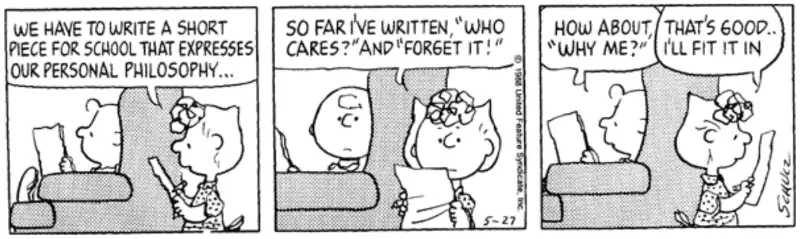
Visual humor transforms abstract philosophical concepts into tangible, memorable experiences. Research shows that combining visual elements with humor enhances retention and comprehension, creating multiple pathways for understanding complex ideas. The power lies in how visual metaphors connect abstract thoughts to concrete experiences we all share.
The Power of Metaphors
The universal metaphor of the labyrinth exemplifies this perfectly. In The Labyrinth, the maze represents human existence – its twisting corridors and dead ends mirror life’s complexities and choices. When readers see two rats navigating this elaborate structure, they immediately grasp existential concepts through familiar imagery. The humor emerges naturally from the contrast between the maze’s grand philosophical symbolism and the simple quest for cheese, creating an accessible entry point to deeper ideas.
Visual humor works particularly well in philosophy because it bridges the gap between abstract thought and lived experience. Consider the banana peel metaphor for reality: when a contemplative rat, lost in thought, suddenly slips on a banana peel, readers instantly understand how reality intrudes into our mental constructions and fantasies.
Visual Humor in Comics
Studies in educational psychology support this approach. Research published in the Journal of Instructional Research (McCabe et al., 2017) reveals key insights about humor. It demonstrates how humor captures attention and enhances motivation—crucial elements for engaging with challenging content. Moreover, comics provide multiple cognitive cues through their combination of visual and textual elements, leading to improved comprehension and retention rates compared to traditional text-only formats.
The timing and placement of visual humor play crucial roles in philosophical comics. Strategic panel sequences build anticipation, while careful pacing allows readers to process complex ideas before hitting them with humorous insight. This creates what educators call “cognitive shortcuts”. These are memorable moments that anchor abstract concepts to concrete experiences. When readers later encounter these philosophical ideas in other contexts, visual humor serves as a mental hook for understanding.
Furthermore, visual metaphors in comics transcend language barriers and cultural differences, making philosophical concepts more universally accessible. A rat in a maze speaks to everyone, regardless of their background. And in addition, the visual nature of comics allows readers to process information at their own pace, returning to images and finding new layers of meaning with each viewing.

Humor Theories in Action: Breaking Down Complex Ideas Through Comics
Humor theories come alive in philosophical comics, transforming abstract concepts into engaging visual narratives. By examining specific examples from The Labyrinth, we can see how each theory contributes to making complex ideas accessible while maintaining their philosophical depth.
Superiority Theory of Humor
Superiority Theory creates powerful moments of insight through perspective shifts. In a striking sequence, we see a rat from high above, tiny and lost in a maze. This bird’s-eye view reveals the full scope of the labyrinth stretching in all directions, trapping the protagonist. The visual punch line works on multiple levels. Readers experience both amusement at the rat’s predicament and recognition of their own similar position in life, creating that characteristic mixture of superiority and self-awareness that makes philosophical humor so effective. Through this elevated perspective, we realize we are all like this rat, navigating the labyrinth of existence.
Relief Theory of Humor
Relief Theory provides necessary breathing spaces within heavy philosophical discourse. The strategic use of expressive rat characters, with their exaggerated emotions and gestures, offers welcome relief from Sartre’s challenging concepts. This approach follows a crucial principle in philosophical comics: humor should emerge naturally from the material rather than feel forced. Like a pressure valve, these moments of levity release accumulated tension, allowing readers to process complex ideas before moving forward. The key lies in intuitive timing – knowing when readers need that relief to maintain engagement with the material.
Incongruity Theory of Humor
Incongruity Theory shines in creating unexpected connections that illuminate philosophical concepts. Consider a sequence where a rat contemplates life’s fundamental questions while lying in bed. Instead of arriving at a profound revelation, he asks, “Why not simply stay in bed?” This sudden change of direction highlights existential choices with humor, making a complex philosophical concept immediately relatable. The incongruity between the setup’s gravity and the punchline’s mundane wisdom creates both laughter and understanding.

Combining the Three Theories of Humor
The most powerful moments often combine multiple humor theories. Consider the sequence illustrating Sartre’s concept that we are “thrown into existence”. We see a rat literally thrown from the sky, crashing to the ground, while the text ironically declares we are “blessed with life”. This scene employs all three theories: incongruity in the literal interpretation of “thrown”, relief from the tension of contemplating existence, and superiority in recognizing our shared predicament. The sequence continues with the rat invoking Descartes – “I think therefore I am…” – only to conclude, “…in trouble” while gesturing dramatically in the maze. This masterful combination uses Cartesian philosophy as a setup for a punchline that encapsulates the human condition.
The effectiveness of these humorous approaches varies among readers, reflecting humor’s personal nature. What triggers laughter in one person might elicit only thoughtful recognition in another. However, this variety actually strengthens philosophical comics as a medium. Different types of humor create multiple entry points for understanding, ensuring that readers remain engaged even if not every joke lands.
The key to balancing humor while maintaining philosophical clarity lies in organic development. Rather than engineering jokes, successful philosophical comics let humor emerge naturally from the interplay between characters, situations, and ideas. This intuitive approach ensures that humor serves the philosophical content rather than overshadowing it.
Research supports this multi-layered approach to philosophical humor. Studies show that when readers encounter ideas through multiple cognitive pathways – visual, verbal, and humorous – they develop deeper understanding and better retention. The combination of humor theories at work in philosophical comics creates these multiple pathways naturally, making abstract concepts more accessible without simplifying them.
Through this strategic application of humor theories, philosophical comics transform potentially dry or intimidating concepts into engaging explorations that readers can approach from multiple angles. The result is not just better understanding, but a more enjoyable journey through complex philosophical terrain.
Why Comics Are the Best Way of Doing Philosophy
Comics offer unique advantages for conveying philosophical ideas that make them perhaps the most effective medium for philosophical exploration. By combining visual storytelling with thoughtful text, comics create multiple pathways to understanding that make complex concepts accessible to everyone, not just academics.
The Unique Structure of Comics
The magic of comics lies partly in what isn’t shown – the white space between panels, known as “the gutter”. These spaces engage readers’ imaginations, inviting them to participate actively in meaning making. When exploring philosophical concepts, these natural pauses create room for reflection, allowing readers to process ideas at their own pace. Unlike films, which move relentlessly forward, comics let readers pause, flip back, and review concepts until they achieve understanding. This flexibility proves especially valuable when dealing with challenging philosophical ideas.
The combination of text and images in comics creates a unique synergy that enhances comprehension. Take the example from The Labyrinth, where two juxtaposed panels explore how humans create meaning in a meaningless universe. The first panel shows stars connected by lines forming constellations, while the second shows the same stars without connections. This visual metaphor instantly communicates what might take pages of text to explain – how humans impose patterns and meaning onto raw existence. The visual element makes the abstract concept concrete and immediately graspable.
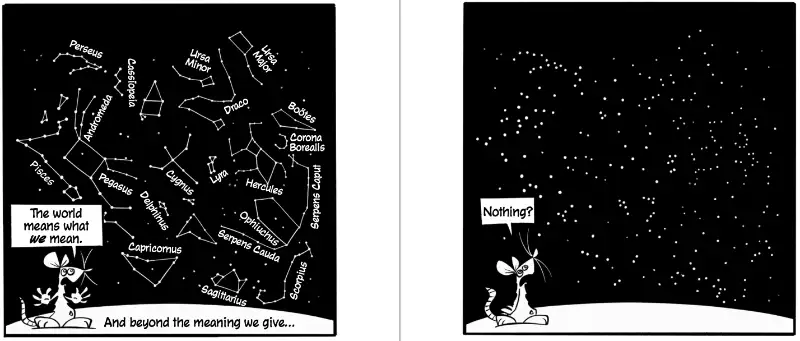
Comics also excel at making philosophical ideas emotionally resonant. Comics use character expressions, visual metaphors, and strategic humor to transform complex ideas. Through these tools, even seemingly pessimistic philosophies like Sartre’s existentialism become engaging explorations of human experience. The visual nature of the medium helps readers connect emotionally with abstract concepts, making them more memorable and meaningful.
From Complexity to Accessibility
Research in educational psychology supports the effectiveness of comics as a teaching tool. Studies show that the combination of visual and textual information improves retention and understanding compared to text alone. The comic format’s ability to present information in digestible chunks, supported by visual cues, helps readers build complex understanding progressively.
The apparent simplicity of comics belies their philosophical power. As one reader noted about The Labyrinth, “It may seem like a complex story, but it’s not. As everything is illustrated, you can get in touch with existentialist philosophy and understand various concepts that imply a perspective on being, freedom, choices, responsibility and authenticity.” This accessibility doesn’t come at the cost of depth – rather, it makes philosophical depth available to more people.
Comics achieve this accessibility through their unique ability to create what might be called “concrete abstractions”. By representing abstract concepts through visual metaphors and characters, comics bridge the gap between theoretical understanding and lived experience. The medium’s inherent unreality – its deliberate simplification and stylization – paradoxically allows it to capture and communicate truth more effectively than strictly realistic media.
Perhaps most importantly, comics democratize philosophy. Comics make complex ideas accessible without oversimplifying them. In doing so, they fulfill philosophy’s original mission: helping people understand fundamental aspects of existence. When philosophical insights become available to everyone, not just specialists, philosophy can better serve its purpose of illuminating the human condition.
Conclusion
Humor theories illuminate how comics transform complex philosophical ideas into engaging, memorable experiences. Through superiority, relief, and incongruity, visual humor creates multiple pathways to understanding abstract concepts. When combined with comics’ unique ability to present concrete abstractions, this approach makes philosophy accessible without sacrificing depth or nuance.
The success of philosophical comics lies in their ability to meet readers where they are, using familiar visual metaphors and strategic humor to build bridges to complex ideas. Whether it’s a rat contemplating existence while searching for cheese, or stars connecting into constellations that reveal how humans create meaning, these visual stories resonate on both intellectual and emotional levels.
Comics accomplish what traditional philosophical texts often struggle with: they make abstract concepts tangible and relatable while creating space for readers to engage actively with ideas. The combination of visual storytelling, thoughtful humor, and reader-controlled pacing creates an environment where philosophical exploration becomes both accessible and enjoyable.
As we continue to grapple with life’s fundamental questions, comics offer a powerful medium for philosophical discourse. Their ability to distill complex ideas into visual narratives while maintaining intellectual rigor makes them uniquely suited for exploring philosophical concepts in our increasingly visual world.
Ready to explore more about how comics illuminate life’s big questions? Visit my blog at benargon.com/blog, where I regularly share insights about turning abstract ideas into visual stories you can see and feel.
Written by Ben Argon (https://benargon.com/), philosophy comics author, 14 February 2025.