Philosophy Comics: Essential Guide (2026)
Philosophy comics are graphic narratives that explore fundamental questions about existence, ethics, knowledge, and meaning through visual storytelling. What if understanding life’s big questions was as simple as reading a comic book? As philosophy comics author and maker of The Labyrinth, I have found that visual storytelling is an effective way to explore deep ideas that is both enlightening and, dare I say, fun.
Philosophy is about the questions we all face. Who are we? What is the meaning of life? How do we deal with death? These questions emerge when we’re making life choices, navigating relationships, or simply trying to find happiness.
While traditional philosophy can feel intimidating, comics and graphic novels offer a more inviting path. Through superheroes grappling with moral dilemmas or cartoon characters pondering existence, these works transform complex philosophical ideas into visual stories that speak directly to us.
In this guide, I share my ten favorite philosophy comics—updated for 2026—each offering a unique gateway to philosophical thinking. Whether you’re curious about life’s big questions or a comics reader ready to explore deeper themes, there’s something here for you.
What’s new in 2026: This guide now includes recent philosophy comics like Aristotle: A Graphic Biography (2024), signaling an encouraging trend toward more philosophical graphic novels in English. I’ve also added The Arrival, a wordless masterpiece that embodies philosophy through its very structure. These additions reflect my ongoing exploration of how comics can make life’s deepest questions visible.
What Makes Philosophy Comics Special?
Philosophy comics combine philosophical thinking with visual storytelling, making complex ideas easier to understand and more engaging to explore. As an author of philosophical comics, here’s how I explain why comics can make complex ideas clearer than traditional texts.
First, they appeal to both sides of the brain. When words and pictures work together, as they do in comics, they create understanding that neither can achieve alone. Second, comics let ideas unfold naturally over time over the course of the story. By breaking down complex philosophical concepts into visual stories, readers can see abstract ideas in action.
And perhaps the most powerful aspect is how comics can make abstract ideas tangible through visual metaphors. Philosophy often describes concepts with words, but comics can communicate philosophical ideas visually in an emotionally resonant way, and thereby make these ideas understandable for everyone. For example, in my graphic novel The Labyrinth, I use the maze as a symbol for the complexity of life and the many choices we face.
The combination of text and pictures, sequential visual storytelling, and the use of visual allegories make philosophy more accessible and offer different ways to understand big questions.
Ways Comics Bring Philosophy to Life
I’ve found four main ways comics and philosophy come together.
First, there’s what I call “Philosophy IN Comics” where philosophical ideas emerge naturally as part of the story. For example superhero comics tackling moral dilemmas or slice-of-life stories exploring existential questions. These works weave philosophical ideas into engaging narratives, making complex ideas relatable.
Then we have “Philosophy THROUGH Comics” where creators deliberately set out to explain philosophical concepts. These educational graphic novels use visual storytelling as their classroom, making abstract ideas concrete through clever illustrations and metaphors. They show rather than just tell the stories of philosophical thought.
“Philosophy OF Comics” examine how comics themselves shape our understanding. These works explore how the unique features of comics – panels, gutters, page layouts – influence how we perceive and process information.
Finally, there’s “Philosophy AS Comics” where form and content become inseparable. These often more experimental works don’t just use comics to explain philosophy: they create philosophical experiences that could only exist in comic form. Having worked in this space myself, I find this approach particularly exciting – it’s where comics push the boundaries of how we can think about and experience philosophical ideas.
Top TEN Philosophy Comics
Philosophy In Comics
Here, philosophical insights emerge naturally through compelling stories — from Greek mythology graphic novels to existential noir. These works weave deep questions into engaging narratives, letting readers discover profound ideas while following fascinating plots.
1. Watchmen by Alan Moore and Dave Gibbons
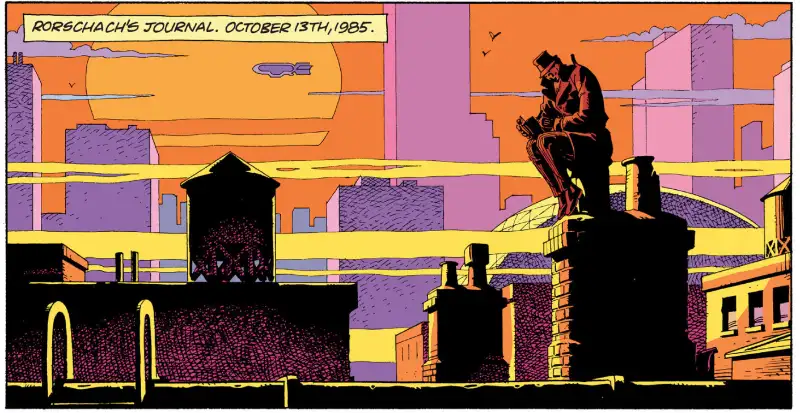
If superheroes lived in our world, what would they be like, and what choices would they make about right and wrong? Watchmen explores these questions in a clever way. The story is set in an alternate 1985 where costumed vigilantes face difficult choices about what is right and wrong. This comic book looks at ideas like justice, power, and what happens when people try to do “good”—themes that connect directly to questions about where tyranny begins.
Through Allan Moore’s intricate, multilayered storytelling and Dave Gibbons’ precise cinematographic artwork, Watchmen revolutionized what comics could achieve. The famous question “Who watches the watchmen?” leads readers into deep questions about power and accountability. Gibbon’s nine-panel grid creates a rhythm perfect for the action-driven story and for examining cause and effect, while details that happen in the background of the main action reward careful readers with additional layers of social and philosophical commentary.
Why I recommend this comic: I’ve always found it difficult to embrace traditional superhero themes – the clear-cut battles between good and evil feel distant from how morality actually works. Watchmen is the only superhero story I’ve truly connected with, precisely because it’s so anti-heroic. These are real people masquerading as superheroes, and the story captures politics and morality as they occur in the real world: messy, compromised, and endlessly complex.
2. Peanuts by Charles M. Schulz
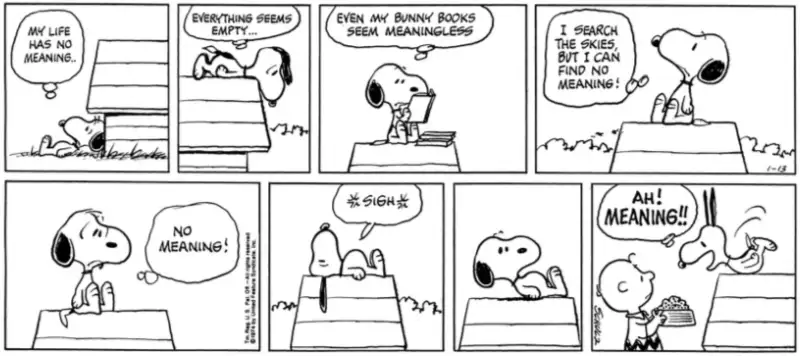
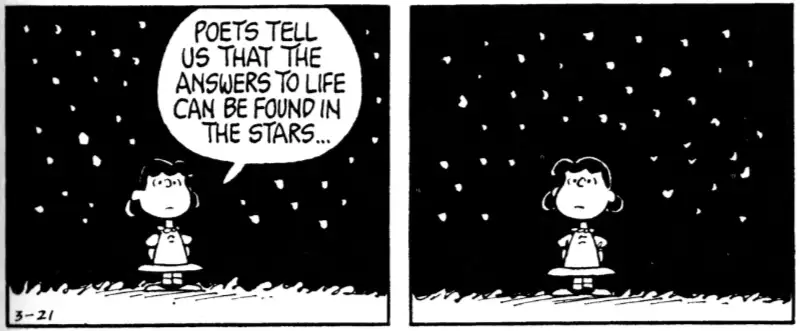
Behind Charlie Brown’s endless attempts to kick that football lies one of the most profound explorations of human nature in comic form. Every time Lucy pulls the ball away, she’s not only tormenting poor Charlie Brown but she’s helping us examine the human condition.
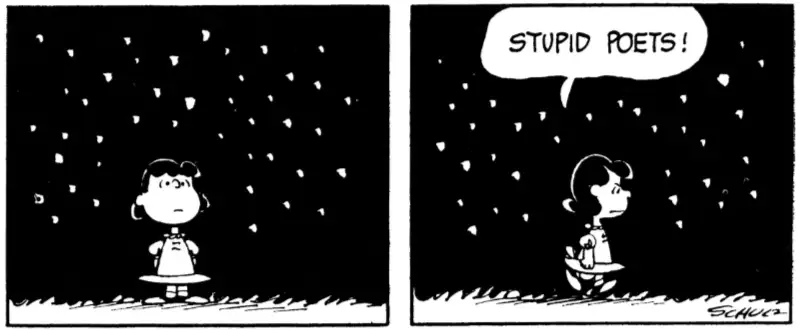
Through its cast of children (and one philosophically inclined beagle), Peanuts explores life’s complexities with remarkable depth and humor. Charlie Brown becomes a modern Sisyphus grappling eternally with existential questions, while Snoopy’s rich fantasy life examines how we make up our reality. Schulz’s minimalist art style and three or four-panel format turn each strip into a small philosophical story, delivering wisdom with a gentle smile.
Why I recommend this comic: I first discovered Peanuts as a kid, laughing at Charlie Brown’s misfortunes. With each rereading over the years, I’ve found deeper layers of meaning – from lessons about perseverance to insights about existence itself. There are so many books that reprint Peanuts it’s hard to know what book to pick. I recommend picking a book that collects all strips in the sequence they were originally published in newspapers. Start with the mid-1960s collections, for instance 1969–70. Read just a few strips at a time. These comics were written to be read a-strip-a-day and they lose their impact and wit when you read too many at once.
3. A Distant Neighborhood by Jirô Taniguchi

What would you discover if you could return to your childhood with your adult mind intact? Through the story of a businessman mysteriously transported back to his teenage years, Taniguchi creates a meditation on memory, identity, and time that works wonders in comic form.
This award-winning manga uses its time-travel premise to explore questions far deeper than simple “what if” scenarios. As the protagonist navigates his past with future knowledge, we confront universal questions: Can we truly change? Did we make the right choices? Does understanding our past free us or trap us? Taniguchi’s detailed artwork and thoughtful pacing create space for reflection, while his carefully structured panels alternate between action and moments of contemplation.
Why I recommend this comic: This work was my gateway into manga, and it remains a favorite. Through its beautiful artwork and touching narrative, it explores something we all experience – the desire to return to childhood and remain childlike throughout our lives. It’s not about traveling to the past; it’s about living our future by understanding who we are across time to live a good life.
Philosophy Through Comics
Now let’s explore works that deliberately set out to explain philosophy, but don’t worry – these aren’t dry textbooks! These comics transform philosophical concepts and history into engaging visual stories.
4. Philosophy: A Discovery in Comics by Margreet de Heer

Imagine having a witty friend who can draw and happens to love explaining philosophy. That’s what reading de Heer’s work feels like. She takes us on an illustrated journey through the history of Western philosophy, starting with a deceptively simple question: “What is thinking?”
What makes this comic special is how it builds understanding step by step. De Heer appears as a character in her own story, often chatting with her husband about big ideas – a clever nod to philosophy’s tradition of dialogue. Through her charming artwork and infographic style, abstract concepts become approachable without losing their depth. We move from ancient Greece to modern thought through clear visual metaphors that stick in your mind.
Why I recommend this comic: I admire how de Heer makes philosophy feel like a friendly conversation rather than a lecture. It’s perfect for beginners, but even more experienced philosophy readers will appreciate her fresh take on classical ideas. Start here if you want a solid foundation in philosophical thinking that doesn’t feel like homework.
5. Sophie’s World by Vincent Zabus and Nicoby
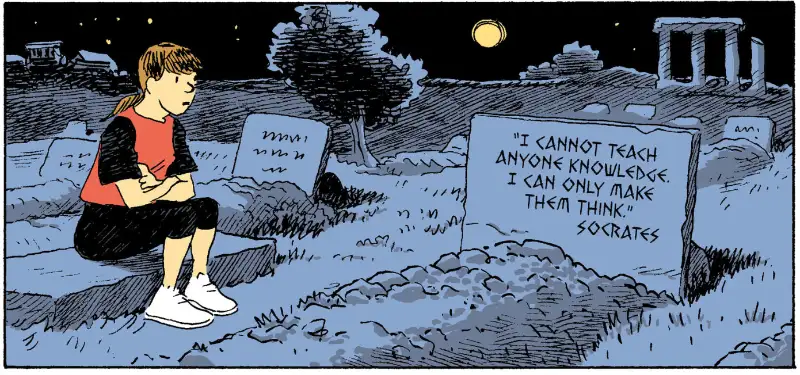
The story kicks off when mysterious letters about philosophy start appearing in a young girl’s mailbox… This enchanting adaptation of Jostein Gaarder’s beloved novel turns philosophical discovery into a visual adventure, making complex ideas jump off the page.
The graphic novel follows Sophie’s journey through the history of philosophy. But instead of just telling us about different philosophers’ ideas, it shows us Sophie playfully experiencing them. Through her curious eyes, we explore questions about existence and meaning that feel fresh and relevant. The artists use color and panel design brilliantly – creating contemplative moments when Sophie ponders big ideas, then bursting into dynamic sequences as concepts come alive.
Why I recommend this comic: While I love Gaarder’s original novel, this adaptation does something special by making philosophy visual. It’s perfect for visual learners or anyone who finds traditional books off-putting. The story pulls you in so naturally that you might not even realize how much philosophy you’re absorbing along the way.
6. Aristotle: A Graphic Biography by Tassos Apostolidis and Alecos Papadatos

How do you make one of history’s most influential philosophers feel like a contemporary teacher? This 2024 graphic novel finds an ingenious solution through dual narrative. Blue-tinted sections show Theophrastus teaching his own students; brown sections reveal historical scenes from Aristotle’s life. Through Theophrastus’s eyes, we become fellow students, listening as he recounts the tale of this philosophical giant.
The creative team brings exceptional credentials: writer Tassos Apostolidis is a respected Greek educator, while illustrator Alecos Papadatos previously created the acclaimed Logicomix. Together, they’ve crafted a beginner’s guide to Aristotle that feels as engaging as it is illuminating.
The illustrations incorporate teaching materials seamlessly: classroom displays, billboards, clarifying diagrams. When exploring Aristotle’s categorization of beings, a simple table breaks down how we might characterize something as commonplace as a dog. When discussing cosmology, carefully crafted visual metaphors bring the earth-centric model to life.
Particularly powerful is the treatment of political philosophy. In Pan’s grotto beneath the Acropolis, Aristotle secretly meets with Aeschines, an exiled orator returned after losing a bitter political battle. Their clandestine discussion resonates with contemporary debates about democracy’s strengths and vulnerabilities.
Why I recommend this comic: During a recent visit to Athens, walking through the Ancient Agora where these conversations once took place, I was struck by how this graphic novel captures the vibrant intellectual atmosphere of classical Greece. It shows not just Aristotle’s theories but the human being behind them – a perspective often lost in traditional philosophy books. For more on where to start with Aristotle, see my guide to Aristotle books.
Further Reads
Logicomix: An Epic Search for Truth by Apostolos Doxiadis, Christos H. Papadimitriou, Alecos Papadatos, and Annie Di Donna – The quest for mathematical truth told as a gripping thriller. Through philosopher Bertrand Russell’s story, this graphic novel turns the search for logical certainty into an intellectual adventure, weaving together Russell’s lecture at the outbreak of WWII, his personal journey, and the authors’ own struggles to tell this story. Perfect for readers interested in how mathematics and philosophy intersect.
Verissimus: The Stoic Philosophy of Marcus Aurelius by Donald Robertson and Zé Nuno Fraga — A 250-page biographical epic that tells Marcus Aurelius’s life story through surviving Roman histories while interweaving Stoic philosophy from the Meditations. Fraga’s historically grounded artwork externalises what the journal keeps internal — you see the emperor wrestling with Stoic principles through plague, war, and betrayal. For the full range of Marcus Aurelius reading, see my guide to Marcus Aurelius books.
Philosophy Of Comics
Here’s something unique: a work that examines how comics themselves shape our understanding of reality. By studying the medium itself, we gain fascinating insights into how we think, perceive, and create meaning.
7. Understanding Comics by Scott McCloud

What better way to understand how comics work than through a comic about comics? McCloud pulls off something brilliant here – he uses the medium to examine itself, turning what could have been a dry theoretical study into a visual adventure.
Through simple black and white illustrations and a cartoon version of himself as guide, McCloud explores everything from how our brains fill in the gaps between panels to why simplified drawings can feel more real than detailed ones. He shows rather than tells – when explaining how comics handle time differently from other media, he literally manipulates the panels to demonstrate. It’s like watching a magician reveal their tricks.
Why I recommend this comic: From my perspective as a creator, this book influenced how I think about visual storytelling. Even if you’re not making comics, it offers fascinating insights into how we process visual information and create meaning. Think of it as a behind-the-scenes tour that makes every comic you read afterward more interesting.
Further Reads
99 Ways to Tell a Story: Exercises in Style by Matt Madden – Where McCloud explains how comics work, Madden shows it through demonstration. Taking one simple eight-panel sequence – a man getting a glass of water – he retells it 99 different ways: as manga, as ligne claire, as superhero comic, as silent film, as political cartoon. The effect is revelatory, showing how rich comics storytelling can be and how distinctive certain traditions appear when isolated. A perfect companion to Understanding Comics.
From my studio
I made a 15-page comic asking the questions philosophers have wrestled with for centuries: Who am I? What is life all about? Same visual approach as my Eisner-nominated graphic novel The Labyrinth – existentialist ideas made entertaining. Get it free here.
Philosophy As Comics
Now we enter experimental territory. These innovative works don’t just explain philosophical ideas – they embody them through their very structure. Form and content become inseparable, creating experiences that could only exist in comic form.
8. Building Stories by Chris Ware
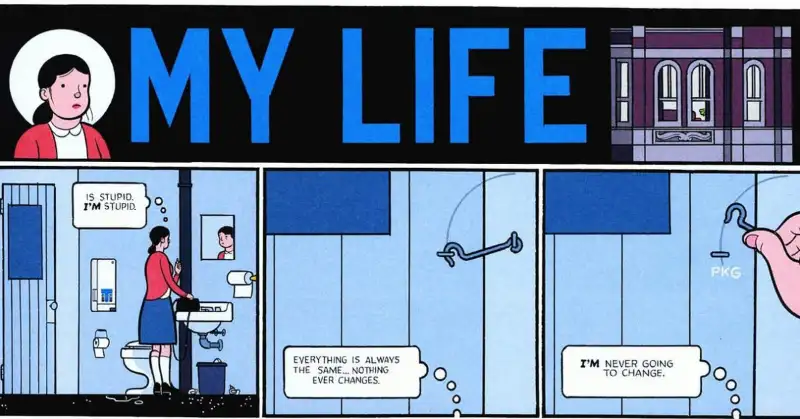
You order a comic and what you receive is what looks like a board game box. Inside, you’ll find 14 different printed pieces – books, newspapers, flip books – that together tell the story of a woman living in a Chicago apartment building. But this unusual format isn’t just clever packaging; it’s a demonstration about how we construct meaning from the fragments of our lives.
Through this innovative approach, Chris Ware creates a meditation on memory, choice, and human connection. There’s no “right” order to read the pieces – you build the story as you go, just as we piece together understanding in our own lives. His meticulous artwork and creative layouts turn each page into a philosophical exploration of how we experience time and memory.
Why I recommend this comic: When I first opened my copy, I was puzzled and intrigued. Like life itself, it doesn’t give you easy instructions – you explore, discover connections, and create meaning along the way. It’s perfect for readers ready to push beyond traditional storytelling into something more experimental.
9. Here by Richard McGuire
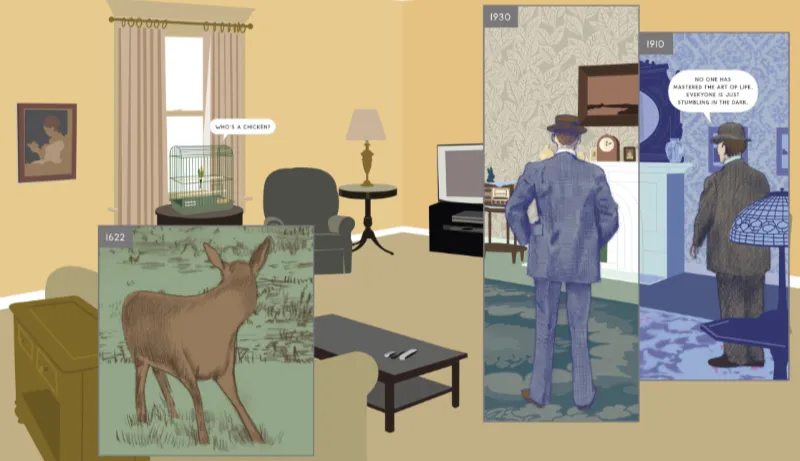
In Here a single corner of a room tells the story of time itself. In this innovative work, McGuire takes a fixed spot in space and shows us countless moments in time that occurred there – from prehistoric eras to the distant future – creating a meditation on permanence and change that could only exist in comic form.
Originally a six-page story that McGuire expanded into a full graphic novel, Here plays with comics’ unique ability to show multiple time periods simultaneously. Through clean artwork and clever layouts, we might see a family gathering in 1957 overlaid with a glacier from 30,000 BCE and a child’s birthday party in 2015 – all in the same physical space. The effect is both profound and surprisingly emotional, making us think about our brief moment in time.
Why I recommend this comic: As a creator fascinated by how comics can explore time differently from other media, I find Here innovative. Unlike film, which must move forward, comics let readers move freely through time by turning pages back and forth. Here takes this unique quality and turns it into a philosophical experience about existence and impermanence.
10. The Arrival by Shaun Tan
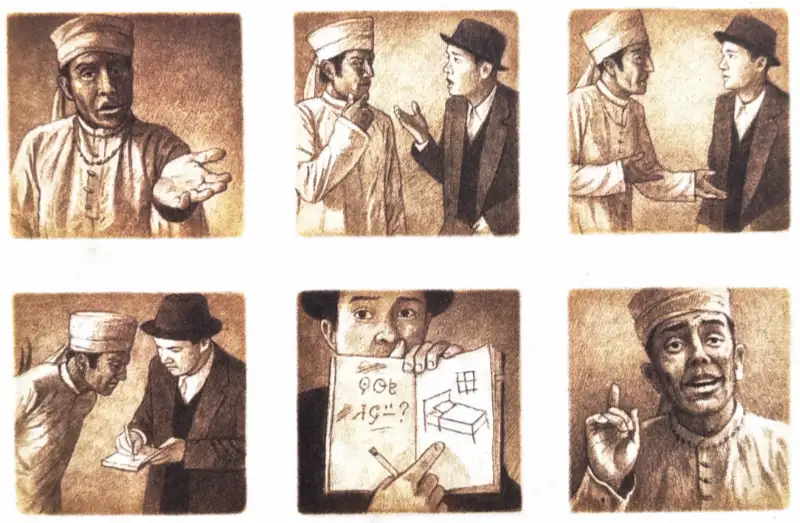
A man leaves his family to find work in a strange new land. What follows is a wordless journey through a world of surreal architecture, incomprehensible symbols, and alien customs – yet somehow deeply, achingly human. The Arrival is a masterpiece about migration, alienation, and the courage of beginning anew.
This book belongs in “Philosophy AS Comics” for a specific reason: its very structure makes us live the migrant’s experience. The absence of words forces us to make sense of an unfamiliar world exactly as the protagonist must. Nor can we read the signs, nor do we understand the customs. We must piece together meaning from context, gestures, and images alone. The philosophical experience – understanding alienation from the inside – could only exist in this wordless comic form.
Tan’s art – expressive, haunting, deeply human – proves that entire universes can be conveyed without a single word. Through sepia-toned illustrations that evoke vintage photographs, he creates a world both strange and familiar, threatening and welcoming.
Why I recommend this comic: Having moved between countries and cultures throughout my life, I recognize the experience Tan conveys so skillfully – that disorientation of being a stranger and the small victories of learning to navigate an unfamiliar world. Yet The Arrival carries a quietly optimistic, empowering spirit. It’s not just about alienation; it’s about the freedom of beginning anew. A stunning work I recommend wholeheartedly.
Further Reads
Unflattening by Nick Sousanis – The first Ph.D. thesis in comic form, exploring how visual thinking frees us from narrow, “flat” ways of seeing. When Sousanis wants to show how to break free from one-dimensional thinking, he literally transforms 2D drawings into 3D on the page. More academic than other entries here, but remarkable in how it transforms ideas about perception into visual experiences. For readers interested in epistemology – how we know what we know – this offers a unique philosophical journey.
From My Studio: The Labyrinth

My Eisner Award-nominated graphic novel explores life’s meaning through Sartre’s existentialism. Two rats trapped in a maze – a simple metaphor for profound questions about freedom, choice, and the search for meaning.
What professional reviewers have said: Publishers Weekly noted how the comic makes “expansive concepts like the nature of reality, the experience of time, and understanding the self” accessible through “clear visual metaphors.” Library Journal called it “a great primer for anyone, especially young adult readers interested in existentialism.”
The project emerged from my own struggle with Sartre’s dense Being and Nothingness – and my desire to make these often misunderstood existentialist ideas more approachable.
If you’d like a taste of this approach, I made a short companion piece. What Is Life All About? is a 15-page comic in the same style — philosophy’s ultimate question, made visual and entertaining. It comes with a free visual guide to Wally Wood’s 22 Panels That Always Work. Get it free here.
How to Choose Your First Philosophy Comic
Here’s the best part: you don’t need any background in philosophy to dive in. These works let you absorb profound ideas naturally, often while simply enjoying a good story.
Start with what interests you:
—For an overview of philosophical history: Philosophy: A Discovery in Comics or Sophie’s World
—For learning through compelling stories: Watchmen or A Distant Neighborhood
—For a specific philosopher’s ideas: Aristotle: A Graphic Biography, Verissimus for Marcus Aurelius and Stoicism, or The Labyrinth (for Sartre)
—For understanding how comics work: Understanding Comics
—For experimental, boundary-pushing work: Building Stories, Here, or The Arrival
The magic lies in how these works make big ideas feel accessible and even fun. You might find yourself pondering life’s meaning while following rats through a maze, contemplating time in a single corner of a room, or experiencing a migrant’s alienation through wordless images. Let the stories wash over you, enjoy the artistry, and don’t worry if you don’t grasp every concept immediately.
Sometimes the deepest thinking happens when we’re simply having fun.
Frequently Asked Questions
Not at all! These works are designed to make philosophy accessible. They build understanding gradually through stories and visuals. You absorb complex philosophical ideas without even realizing it!
Philosophy: A Discovery in Comics offers a great introduction. If you prefer more story-driven works, try Sophie’s World. For superhero fans, Watchmen provides a familiar entry point into philosophical thinking.
Many are! While some works like Building Stories tackle mature themes, others are perfect for younger readers. Peanuts offers philosophical insights for all ages, while Sophie’s World was designed with young adults in mind.
Unlike regular comics, take your time. Pause to reflect when ideas resonate, and don’t worry if you don’t grasp everything immediately. I often find new insights when re-reading these works.
The terms are often used interchangeably. “Philosophy comics” typically refers to any comic – including strips, webcomics, and graphic novels – that engages with philosophical ideas. “Philosophical graphic novels” specifically describes book-length works. This guide covers both, from Peanuts strips to full graphic novels like Watchmen.
Several philosophy comics have received prestigious recognition. Watchmen won the Hugo Award. Maus (a philosophical meditation on trauma and memory) won the Pulitzer Prize. The Arrival won multiple awards including the World Fantasy Award. My own work, The Labyrinth, received an Eisner Award nomination, highlighting the educational power of combining philosophy with visual storytelling.
Originally published on 1 January 2025 | Last updated 6 June 2026
By Ben Argon, philosophy comics creator and author of the Eisner-nominated graphic novel The Labyrinth, exploring the intersection of comics, philosophy, and visual storytelling.