Essential Nihilism Books: A Visual Reader’s Guide to Philosophy’s Darkest Questions
Why Nihilism Books Matter More Than Ever
I first encountered Jean-Paul Sartre’s philosophy through his famous declaration that “existence precedes essence.” This opened a door to existential nihilism. Philosophers describe it as the recognition that existence has no pre-given meaning. While this might sound terrifying, it’s actually liberating and empowering. We are fundamentally free to create our own meaning. This insight sparked my exploration of nihilism books, from classical philosophy to contemporary literature, existentialism books, and philosophy comics.
This realization led me to read Nietzsche, Heidegger, and Camus, along with Sartre. These philosophers proposed ways to overcome the void of meaninglessness. Eventually, this exploration inspired me to create “The Labyrinth.”, an Eisner Award-nominated graphic novel that transforms Sartre’s complex existentialism into visual storytelling.
Nihilistic themes appear everywhere in our current age. We see them amid political disillusionment, climate anxiety, and social fragmentation. They show up in popular culture and personal conversations alike.
Understanding nihilism — and the existential questions it raises — has never been more relevant.
This guide explores both traditional philosophical texts and the emerging field of visual philosophy through comics. It offers readers multiple pathways into life’s most challenging questions through essential nihilism books.

Greatest Voices in Nihilism Books
The Philosophical Foundation
Nihilism comes from the Latin “nihil” meaning nothing. It represents the philosophical position that life lacks inherent meaning, purpose, or intrinsic value. Yet this seemingly bleak worldview has produced some of history’s most profound thinking about human existence and freedom.
Friedrich Nietzsche is often misunderstood as the champion of nihilism. He was actually its most penetrating critic. His famous pronouncement that “God is dead” wasn’t celebratory but diagnostic. He saw nihilism as a cultural crisis that demanded new forms of meaning-creation. Nietzsche understood that traditional sources of meaning were crumbling. And he proposed the übermensch as a response: individuals who could create their own values in a meaningless universe.
Characters like Dostoevsky’s Underground Man embody nihilistic attitudes. But the authors themselves were exploring responses to meaninglessness rather than advocating for it. This tension between depicting nihilism and overcoming it runs through all great nihilistic literature.
From Dostoevsky to Camus: The Literary Evolution
The journey from 19th-century Russian existential despair to 20th-century French absurdism shows philosophy working through the crisis of meaning. Turgenev’s “Fathers and Sons” introduced the first literary nihilist in Bazarov. He’s a character who rejects all traditional authorities and values. Yet Turgenev presents this nihilism as ultimately destructive. It harms both the individual and society. Dostoevsky took this exploration deeper. He showed through characters like Raskolnikov how nihilistic thinking can justify the most terrible acts.
The evolution continued through French existentialists like Sartre and Camus. They inherited the Russian tradition but transformed it. Where Russian nihilism often led to despair, French existentialism proposed radical freedom as the response to meaninglessness. Camus’s concept of the absurd became a starting point for authentic living. He described the conflict between human desire for meaning and the universe’s apparent meaninglessness. Rather than an endpoint of despair, this became a beginning.
This literary tradition prepared the ground for visual philosophical narratives. These authors used character and story to explore abstract concepts. Contemporary comics creators can use sequential art and visual metaphor to make philosophical ideas immediate and visceral. The evolution from text to image represents not a dumbing-down but a sophisticated new form of philosophical debate. It expands how we engage with nihilism books today.
Essential Nihilism Books Every Reader Should Know
Foundational Nihilism Books

Thus Spoke Zarathustra by Friedrich Nietzsche stands as the essential text for understanding the diagnosis of nihilism and proposed cure. Nietzsche’s poetic philosophy introduces the concept of eternal recurrence and the übermensch. These are responses to the death of traditional meaning structures. The work’s aphoristic style makes it surprisingly accessible, though its implications are profound. Among classic nihilism books, this remains the most influential.
The Stranger by Albert Camus offers perhaps the most accessible entry into existential nihilism through literature. Meursault’s indifference to social conventions and his mother’s death illustrates the absurdist position. Life has no inherent meaning. Yet Camus suggests this recognition can lead to authentic freedom rather than despair.
Being and Nothingness by Jean-Paul Sartre provides the most comprehensive existentialist framework for confronting meaninglessness. Sartre’s famous insight is that we are “condemned to be free.” This transforms nihilistic recognition into radical responsibility. While dense, the work rewards patient readers with a complete philosophy. It shows how to create meaning in a meaningless universe. His exploration of “bad faith” remains strikingly relevant today. He reveals the ways we deceive ourselves about our freedom. This connects to contemporary discussions of authenticity and self-creation.
Russian Nihilism Books

Fathers and Sons by Ivan Turgenev introduced the word “nihilist” to world literature through the character Bazarov. He’s a young man who rejects all traditional authorities. Turgenev’s nuanced portrait shows both the appeal and the ultimate sterility of pure negation. This makes it essential reading for understanding nihilism’s literary origins.
Crime and Punishment by Fyodor Dostoevsky presents one of the most psychologically penetrating exploration of moral nihilism in literature. Raskolnikov’s belief is dangerous. He thinks exceptional individuals can transcend conventional morality. This leads to murder and spiritual crisis. Dostoevsky shows how nihilistic philosophy destroys when taken to its logical conclusion. It destroys both the perpetrator and society. The novel explores guilt, redemption, and the necessity of human connection. This provides a powerful counterargument to nihilistic isolation.
The Brothers Karamazov by Dostoevsky contains the famous formulation “If God doesn’t exist, everything is permitted.” This encapsulates the moral crisis that nihilism presents. Through the Karamazov family, Dostoevsky explores different responses to the absence of divine authority.
Contemporary Nihilism Books

Fight Club by Chuck Palahniuk updates nihilistic themes for the era of consumer capitalism. The unnamed narrator’s spiritual emptiness amid material abundance reflects contemporary anxieties. It shows the struggle for meaning in a commercialized world. Palahniuk’s violent imagery serves the same function as Dostoevsky’s psychological penetration. It shocks readers into recognition of their own existential situation.
American Psycho by Bret Easton Ellis pushes nihilistic themes to their logical extreme. Patrick Bateman displays complete moral emptiness. Ellis uses extreme violence and consumer fetishism to create a portrait of late-capitalist nihilism. He forces readers to confront uncomfortable truths about materialism and meaning.
The Trouble with Being Born by E.M. Cioran represents modern pessimistic nihilism in its purest form. Like Nietzsche, Cioran writes in short, sharp fragments rather than long arguments. But while Nietzsche saw nihilism as a problem to solve, Cioran embraces it completely. Nietzsche asked “How do we create meaning after God’s death?” Cioran asks “Why bother?” His brutal honesty about existence’s futility makes for challenging reading. It’s ultimately illuminating.
Academic and Introductory Nihilism Books

Nihilism by Nolen Gertz (MIT Essential Knowledge series) provides an accessible academic overview of nihilistic philosophy. Gertz traces nihilism from its philosophical origins through its cultural manifestations. He offers readers a comprehensive map of the territory. His clear prose makes complex concepts understandable without oversimplification. This stands out among introductory nihilism books for its scholarly rigor combined with accessibility.
The Conspiracy Against the Human Race by Thomas Ligotti is an uncompromising explorations of pessimistic nihilism. Ligotti is primarily known as a horror writer. He applies his dark vision to philosophical inquiry. He argues that consciousness itself is a tragic evolutionary mistake. Drawing on thinkers like Schopenhauer and Zapffe, he presents a stark case. Existence is fundamentally malignant. Our awareness of this fact constitutes the deepest horror. While extremely dark, Ligotti’s work offers valuable insights into the most unforgiving forms of nihilistic thought.
The Myth of Sisyphus by Camus presents a clear philosophical response to nihilistic despair. Camus’s image of Sisyphus is powerful. The Greek hero eternally pushes his boulder up the mountain. He finds meaning in the struggle itself. This provides a practical philosophy for living authentically in an absurd universe. I think that among nihilism books, this offers the most hopeful and actionable response to meaninglessness.
How Comics Transform Nihilistic Philosophy
The Visual Advantage
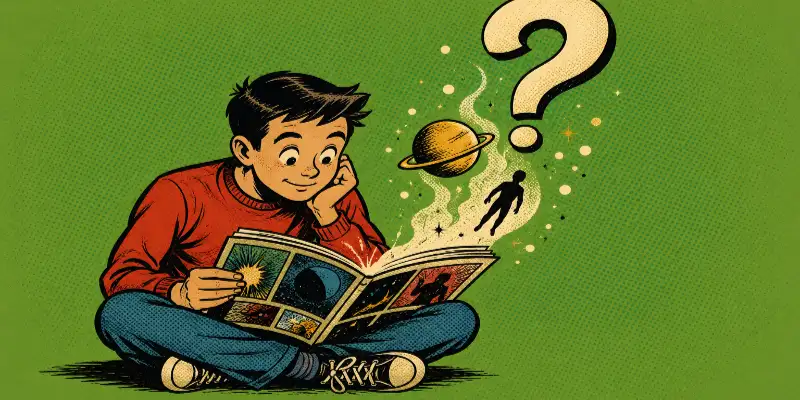
Sequential art possesses something that traditional texts can’t achieve. It requires readers to actively create meaning from images and panel transitions. Where prose tells you about meaning-creation, comics make you practice it. I think this creates a perfect mirror for nihilistic philosophy. Existentialists argue we must actively create meaning in a meaningless universe. Comics readers must actively construct meaning from visual elements that don’t explicitly state their meaning. This makes graphic novels powerful additions to the canon of nihilism books.
In my work as a comics creator I explore how visual storytelling makes abstract philosophical concepts accessible to everyone. We are, fundamentally, a visual species. From cave paintings to modern iconography, we excel at understanding complex ideas through images.
When I started working on “The Labyrinth,” I had concerns. I worried that Sartre’s abstract concepts would resist visual representation. Yet, universal visual metaphors always emerge somehow. Einstein called this “combinatory play.” It’s that free-floating state where ideas recombine without conscious direction. Then the right image suddenly crystallizes in the mind. Abstract ideas like “being thrown into existence” suddenly found their visual form. The rat literally falls from the sky into the world represented as an endless maze.
The key insight? Comics don’t simply illustrate philosophy. Comics create philosophical experiences impossible in other media. A character’s existential crisis gets visualized through artistic technique. The breakdown of meaning becomes visible through panel layout. The weight of choice appears in visual composition. Philosophy transforms from academic exercise into lived experience, panel by panel. It communicates emotionally and not only intellectually.
From My Studio
That power of assembling meaning from panels is what I want to hand readers directly. What Is Life All About? is a 15-page comic drawn in the same style as my Eisner-nominated graphic novel The Labyrinth, circling philosophy’s ultimate question without pretending to settle it. Get it free here.
Alan Moore’s Nihilistic Trilogy

Alan Moore’s three masterworks represent the pinnacle of nihilistic themes in comics. Watchmen, From Hell, and V for Vendetta each approach meaninglessness from a different angle. Together they create a comprehensive exploration of philosophical nihilism through visual storytelling.
Watchmen deconstructs superhero morality to reveal the cosmic insignificance of human moral concerns. Set in an alternate 1985 where costumed vigilantes are real, the story follows flawed heroes investigating a murder. One vigilante, Dr. Manhattan, has god-like powers. His perspective shows human struggles as meaningless against the vastness of time and space. Meanwhile, characters like Rorschach and the Comedian embody different responses to moral nihilism.
From Hell presents the Ripper killings as a dark ritual that births the 20th century. The murders serve as a lens to examine power, madness, and social order’s arbitrary nature. Moore uses the Jack the Ripper murders to explore Victorian society’s nihilistic underpinnings. He suggests that civilization itself rests on meaningless brutality and that historical “progress” is illusory.
V for Vendetta presents Moore’s most directly nihilistic vision: the complete destruction of existing systems as prerequisite for freedom. In a totalitarian future Britain, a mysterious anarchist in a Guy Fawkes mask orchestrates change. He dismantles the fascist state through theatrical terrorism and philosophical conversion. V’s philosophy goes beyond simple anarchism to encompass total negation of imposed meaning structures. Moore and artist David Lloyd’s excellent at using the unique properties of comics to let readers experience both the destruction of old meaning and the terrifying freedom that follows.
Contemporary Nihilistic Comics

Transmetropolitan by Warren Ellis: Set in a dystopian 23rd century mega-city, the series follows Spider Jerusalem as he returns from exile. This eccentric journalist is armed only with his writing and a commitment to truth. He claws against a world that has collapsed into absurdity, presenting social nihilism in action. Ellis’s cyberpunk setting provides the perfect backdrop for exploring how technology drains life of meaning. Jerusalem’s quest for truth in a post-truth society echoes Nietzschean themes of overcoming nihilism through authentic engagement.
Johnny the Homicidal Maniac by Jhonen Vasquez explores psychological nihilism through extreme dark comedy. The comic follows Johnny C., a deeply disturbed young man who commits elaborate murders. He struggles with voices in his head and the apparent meaninglessness of existence. Johnny’s violent response to what he perceives as a meaningless world represents nihilism taken to its logical extreme. Vasquez wraps existential themes in underground comics aesthetic, making profound questions accessible through visceral horror and absurdist humor.
The Sandman: “24 Hours” by Neil Gaiman demonstrates visual storytelling’s unique power to show the moment-by-moment collapse of meaning. In this haunting issue, escaped mental patient John Dee uses a stolen ruby to trap six people. He forces them to confront their deepest truths over 24 increasingly horrific hours in an all-night diner. John Dee’s use of the ruby strips away social pretenses to reveal the meaningless void beneath relationships. The diner setting makes nihilistic themes viscerally relatable as we watch ordinary people destroy themselves. This happens when they’re forced to confront truth without social constructs.
Visual Philosophy in Practice: The Labyrinth

In my graphic novel “The Labyrinth,” I explore the tension between nihilism and existentialism through a deceptively simple story. Two rats find themselves trapped in an endless maze, confronting fundamental questions about existence, freedom, and meaning. They navigate passages that may lead nowhere. The labyrinth itself embodies a nihilistic insight: it has no exit, no final purpose, no built-in meaning. But my rat protagonists are not passive victims of this emptiness.
When they decide, “there is no wrong way: if you don’t get it right, just go left,” they transform the maze into a meaning-making space. Each branch acquires significance only through the act of choosing. While the maze’s structure reflects the absence of inherent meaning, the rats’ choices reflect Sartre’s idea that existence precedes essence. Freedom and responsibility turn even a meaningless labyrinth into a lived path.
The rats aren’t denying the maze’s fundamental purposelessness; they’re choosing to move forward anyway. Through their movement, they create the very meaning that the structure itself lacks. In “The Labyrinth”, the sequential art format allows readers to experience this philosophical shift rather than simply reading about it. This unique capability makes comics particularly powerful for exploring existential themes.
Finding Meaning in Meaninglessness Through Nihilism Books
The works explored in this guide invite us to examine our deepest assumptions about meaning and value. From Nietzsche’s revolutionary insights to contemporary graphic novels, they challenge us to live authentically in an uncertain world. They ask us to create rather than discover purpose. They help us find solidarity with others who share the human condition. We’ve all been thrown into existence without a manual. In facing the void, we discover not despair but our radical freedom. We can create meaning ourselves. Whether you choose traditional nihilism books or philosophy comics, the journey toward authentic meaning-making begins with honest confrontation. We must face life’s apparent meaninglessness.
Published on 15 October 2025 by Ben Argon, creator of the Eisner-nominated philosophical graphic novel The Labyrinth and writer exploring the intersection of comics, philosophy, and visual storytelling at benargon.com